
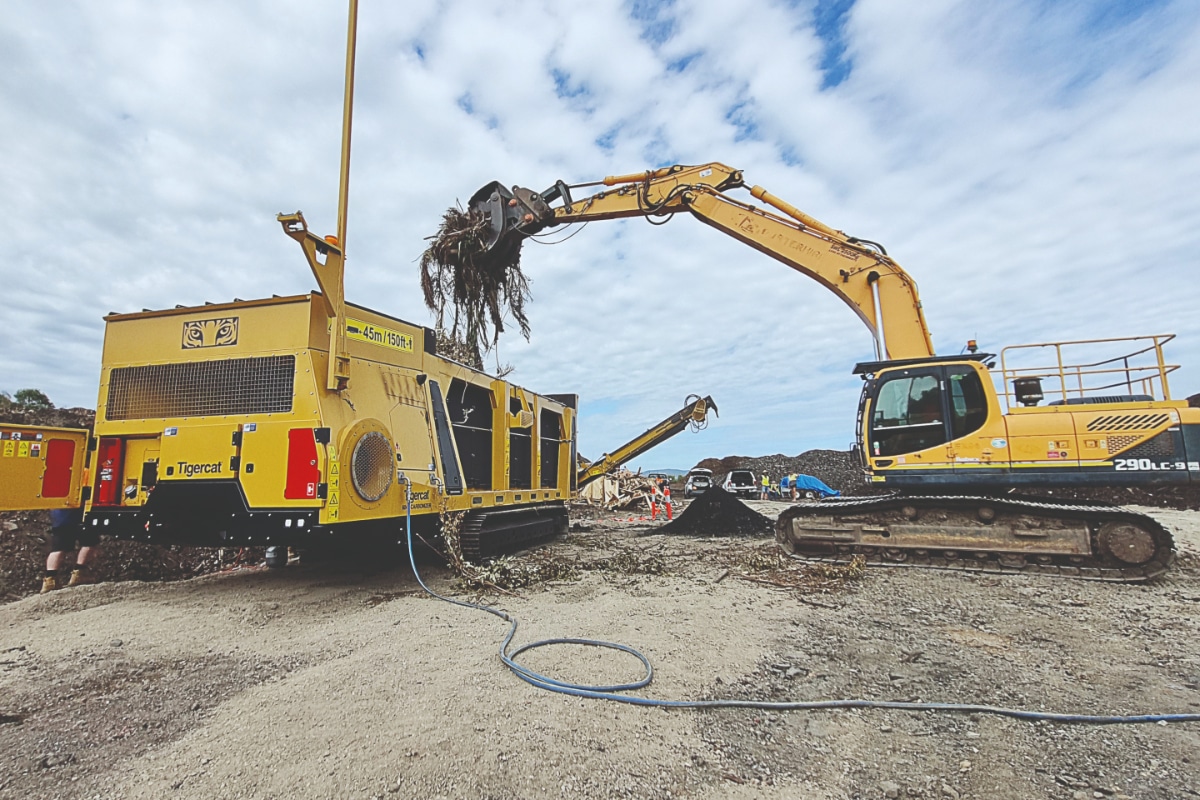
Onetrak is bringing a new machine to Australian shores that could help quarries access a key ingredient of sustainable cement.
In 2025, Holcim partnered with architect Alejandro Aravena to present the world’s first application of a new biochar technology that could transform buildings into carbon sinks.
The project used an advanced, net-zero biochar concrete, with 100 per cent recycled aggregates.
Biochar is created through a process called pyrolysis, where organic materials are exposed to heat in the absence of oxygen, sequestering carbon that would otherwise have been released as CO2. The resulting material can then be added to building materials such as cement, mortar, and concrete to further reduce their carbon footprint and improve overall sustainability.
According to the Intergovernmental Panel on Climate Change, biochar has the potential to eliminate 2.6 billion tonnes of CO2 per year.
Onetrak managing director David Hazell said biochar has been recognised as a potential supplement for cement manufacturing, which makes it a potential benefit for the quarrying industry.
Creating biochar requires pyrolysis equipment – traditionally in the form of fixed plant infrastructure.
“If you have a site where there is a large volume of consistent material coming in over many years, you can justify installing fixed infrastructure,” Hazell said.
“However, so many environments – in particular quarries – are project based. They move around all the time, requiring mobile equipment.”
“The Tigercat 6040 carboniser is one of the only machines globally that incinerates clean, organic material such as green waste, brush, and logs, and converts it into a high-quality biochar.”
The machine inputs woody debris and produces a high-quality organic carbon with up to 90 per cent material reduction. It is an ideal solution for converting unwanted logging and agricultural residue into a useful, high-grade organic carbon that can be left onsite as a soil additive or marketed for many different commercial uses.
The process captures 20 to 30 per cent of the available carbon in the feedstock and sequesters it for thousands of years, furthering the goals of greenhouse gas reduction. The conversion process operates at high throughput levels and produces very low emissions because the gases are combusted in the controlled combustion zone.
Hazell said the growth of Onetrak’s forestry division has encouraged the company to spread its range across industrial sectors.
“We are the proud exclusive distributor of the Tigercat range of equipment,” he said.
“Onetrak supports three key markets – the quarry and extractive industries, forestry equipment, and the waste and recycling market.
“There is the potential to benefit from the Tigercat carboniser across all of these sectors.
“It can support all sorts of things, from invasive weed reduction to organic composting, or easement clearing.
The machine has been designed with ease of maintenance in mind. For example, the grates in the carbonising chamber are made up of seven different sections that can be rotated 180 degrees to balance wear and extend life.
Individual sections can be replaced as required. The undercarriage, auger trough, and conveyor system are all bolt-on sections to the main carbonising chamber frame. Everything can be separated for service and replacement if required. The modular bolt-on design also allows for differing expansion rates of these major components.
The replaceable thermal-ceramic panel seal plate design reduces panel wear, and the panel composition reduces back-face temperature while storing and utilising the energy produced during the carbonising process. This provides a more stable and sustained temperature within the carbonising chamber. The result is increased efficiency, higher infeed rates, reduced emissions, and a greater yield of higher-quality organic carbon.
The auger trough is designed for minimal air leakage, improving under-air efficiency, further defining the secondary combustion zone, and reducing hotspots that could form from an inefficient base pressure or vacuum. Once the organic carbon drops through the grates, it is fully quenched by the water bath. An onboard hydraulic water supply pump and integrated automatic water level control system monitor and manage water consumption. Automated water fill, level control, and water retention provide the operator a window of time to replenish the water supply if required.
The adjustable conveyor simplifies handling and management of the organic carbon product. It pivots 105 degrees from side to side and can be raised or lowered. The conveyor easily folds for transport and does not have to be detached from the frame.
To showcase the new machine’s potential, Onetrak hosted a demonstration day at its Queensland facility.
Hazell said customers from around the country, including Western Australia and Tasmania, were eager to learn about the new machine.
“It was a great event,” he said. “We’ve got people who want to see how it performs, or to get a biochar sample.
“It’s something new, exciting, and environmentally friendly.”
The company operates from seven workshops across Australia, with more than 50 dedicated service staff supporting its products.
Hazell said Onetrak is constantly growing and is excited to help incorporate the Tigercat equipment into the quarrying industry.
“Come and have a look or give us a call to see what we are doing with this new technology,” he said.
“In just a few years, biochar has gone from something that was produced to help grow tomatoes in the back yard into a key part of sustainable cement – with growing demand for industrial production.
“We will continue hosting demonstrations, bringing fresh ideas and new opportunities for the quarry sector.” •
For more information, visit onetrak.com.au
The post Onetrak has its eyes on the Tiger appeared first on Quarry.