
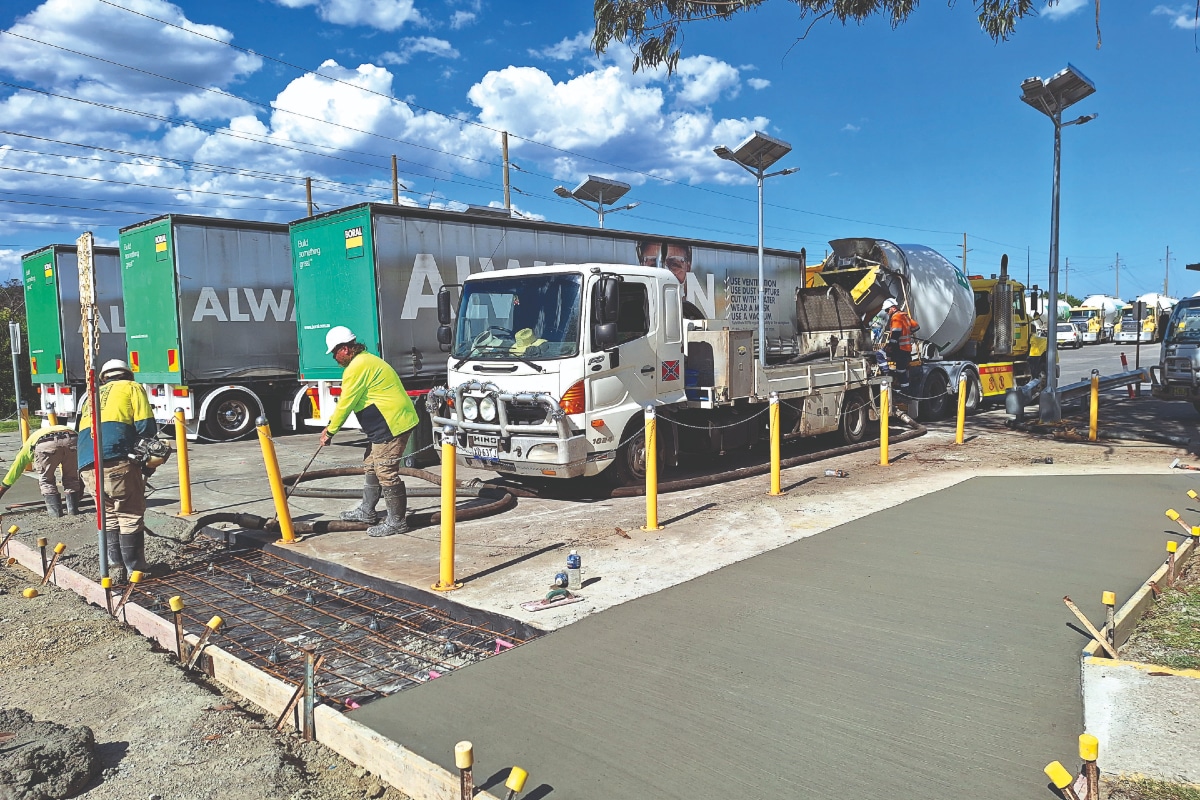
In a major step forward in decarbonisation, Boral has launched its Australian-first calcined clay concrete.
Boral has completed product development of what it describes as Australia’s first low-carbon concrete incorporating locally sourced calcined clay.
Concrete production, particularly cement manufacturing, is one of the largest contributors to embodied carbon in infrastructure due to both energy intensive processing and the chemical release of carbon dioxide. By partially replacing Portland cement with calcined clay, Boral has developed a lower carbon alternative that maintains strength, durability and workability while significantly reducing emissions.
The product has progressed from laboratory research through to large scale field trials at Boral’s Maldon cement operations in New South Wales. The work formed part of a broader collaboration under the SmartCrete Cooperative Research Centre with partners including the University of Technology Sydney, Transport for NSW and Calix.
Boral Head of sustainability and innovation, and project lead, Dr Ali Nezhad, said the results confirm calcined clay is ready for practical application.
“From the laboratory to successful field trials and full product development, our work demonstrates that calcined clay concrete is not just a concept, it works at scale,” Nezhad said. He added that the successful trials have generated strong industry interest in further collaborative projects.
While calcined clay addresses the cement component of concrete, Boral’s broader circular strategy extends deep into its quarrying and recycling operations.
Extending the life of virgin quarry resources is fundamental to this goal of long term sustainability.
Boral has 14 recycling sites across New South Wales, Victoria and South Australia, with additional locations in Queensland set to come online in 2026. Across those facilities, more than 95 per cent of incoming construction and demolition material is processed and returned to market.
Consistency and quality are an important part of the process, which is why Boral has an extensive testing regime internally and externally. One example is Boral’s use of processed recycled glass sand in high grade compaction sand for Sydney Water projects. Following extensive testing and trials with project partners, the material is now approved as a regular component of supply across major Western Sydney infrastructure works.
Returned concrete is another key stream. Rather than sending surplus loads to landfill, Boral has invested in logistics systems that allow unused concrete to be recovered, processed and converted into recycled aggregates suitable for road base and, in some applications, new concrete.
Demand for recycled materials continues to grow, particularly on major infrastructure programs where minimum recycled content requirements are increasingly embedded in contracts.
For quarry operators, the emergence of calcined clay concrete and integrated recycling operations signals a shift in how resources are valued and managed. Supplementary cementitious materials such as calcined clay reduce reliance on traditional inputs, while recycled aggregates help conserve reserves and strengthen supply resilience.
Boral chief executive officer and managing director Vik Bansal said the company is taking a major step forward in its net zero journey.
“Our calcined clay concrete is a major step forward in our innovation journey and progress towards net zero,” Bansal said in the company’s announcement.
“It demonstrates our commitment to developing lower carbon solutions that support Australia’s evolving infrastructure needs.”
The post Boral advances low carbon concrete appeared first on Quarry.